Category Archives: Uncategorized

Failure and Adjustments

Dead and dying lawn and hay fields in mid summer, green forests in the background

This year was an interesting year. I began an entirely new garden project of slightly over half an acre, planted dozens of apples, pears, hazelnuts, and mulberries, a dozen or more grapes, and a dozen blueberries. I brought in 60 yards of mushroom soil and half that of wood mulch, dug and planted six 5′ by 80′ beds of grains, vegetables, flowers, and herbs. I fenced it all in to keep the deer out, set up a gasoline pump to irrigate from the pond (The Farm Pond), and then over the rest of the season watched most of it fail miserably regardless of any efforts on my part.

Central Pennsylvania generally has a mild climate, and doesn’t usually see extremes of any kind except rarely in small doses. We have seen hot, dry summers, the remnants of hurricanes, briefly flooded valleys, late frosts that partly ruin flowering tree crops. This past year we had a dry winter, receiving a total of 6″ of snow for the whole season. In February we had multiple weeks of 60F weather, and in May had frosts down to the low 20s. We had a drought that wouldn’t quit, and a single day of 2″ of rain that just washed everything away instead of soaking in. Now in November, digging to plant garlic has uncovered that the soil is still bone dry. Local farmers exclaimed that in living memory nothing of the sort had ever happened here before, and these farmers are old enough that they should have retired decades ago. Harvests were devastated, many fields were written off as a loss and destroyed, some remain unharvested. Even hay crops were pitifully thin, portending a lean winter to come and thinning of herds on many farms.

Continue reading

1 Comment

Filed under agrarianism, food, homesteading, pond, soil, trees, Uncategorized, water, woods

Black Locust Coppicing, Part 4

Disclaimer: Outside of its native range (in and around the Appalachian Mountain range in Eastern North America) Black Locust – Robinia Pseudoacacia – can become invasive. It is a pioneer species meant to recolonize disturbed ground and compete with grass. If you are outside of its native range please proceed with caution with this species, or consider using a species native to your area that fills the same niche.

Black Locust Coppicing – Part 1, Part 2, Part 3, …, Part 5, Part 6, Part 7

It is now mid-July and the stumps have mostly become unintelligible thickets surrounded with poison ivy. The largest of the sprouts are fully 1 inch in diameter and 8 feet tall. The average sprout is around 0.5 inches in diameter and 5 to 6 feet tall. Most stumps have at least 4 sprouts, but because of the poison ivy I cannot get a detailed count on each individual stump, that count will come during the winter update. We had a historically dry spring in this area, but have gotten lucky recently with intermittent storms during the hottest days bringing us to about an average weekly rainfall for summer. This has not made up for the lack of rain in the spring, but at least is maintaining things on par with a normal hot summer.

Continue reading

8 Comments

Filed under agrarianism, hand tools, homesteading, trees, Uncategorized, woods

Black Locust Coppicing, Part 2

Disclaimer: Outside of its native range (in and around the Appalachian Mountain range in Eastern North America) Black Locust – Robinia Pseudoacacia – can become invasive. It is a pioneer species meant to recolonize disturbed ground and compete with grass. If you are outside of its native range please proceed with caution with this species, or consider using a species native to your area that fills the same niche.

Black Locust Coppicing – Part 1, … , Part 3, Part 4, Part 5, Part 6, Part 7

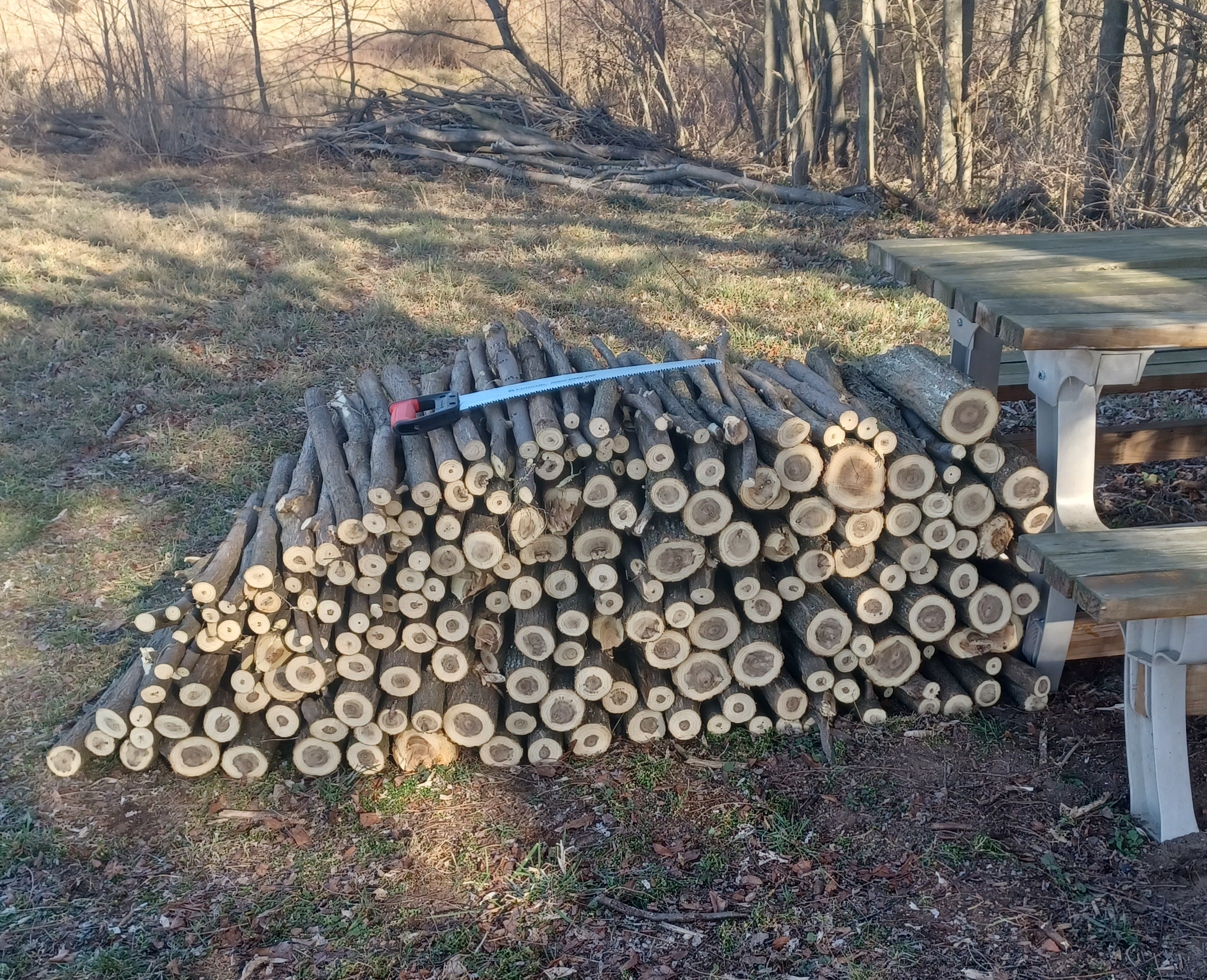
In continuing to document the coppicing project, I have above a photo of the stack of firewood from Plot A. It was cut using the saw in the picture – an 18″ Corona Razortooth pruning saw (Hand Tools: The Simple Choice), which I cannot recommend for out-of-the-box usage of this magnitude. The saw blade itself is fantastically sharp and an efficient cross-cutting tool, but the handle is less than ergonomic and quickly reveals hot-spots and pressure points. Thankfully they have the handle attached to the blade with removable screws and I intend to replace it at some point with a custom wooden handle of the proper shape. Uncomfortable handle notwithstanding, with the help of family (Helpful Children) the wood was cut in less than 3 hours.

Continue reading

9 Comments

Filed under agrarianism, hand tools, homesteading, trees, Uncategorized, woods

Black Locust Coppicing, Part 1

Pile of harvested black locust poles

Disclaimer: Outside of its native range (in and around the Appalachian Mountain range in Eastern North America) Black Locust – Robinia Pseudoacacia – can become invasive. It is a pioneer species meant to recolonize disturbed ground and compete with grass. If you are outside of its native range please proceed with caution with this species, or consider using a species native to your area that fills the same niche.

Black Locust Coppicing – …, Part 2, Part 3, Part 4, Part 5, Part 6, Part 7

In an attempt to move closer to sustainability (Thinking in Long Terms), I have begun the process of coppicing black locusts for many uses, primarily firewood for heating purposes. Black locusts have among the highest BTU’s per cord of North American trees, and have a few properties which make them endearing to me personally and to many of the homesteading persuasion. They are a pioneer species which can compete with grass species favorably if not mowed, are among the fastest growing hardwoods, are leguminous nitrogen fixers, are slightly more deer resistant than other trees due to their sharp thorns, and the wood has been known to last decades as fence posts. Their thorns do make a nuisance for the grower as well as the deer, but a good pair of leather gloves mostly makes it a non-issue. I will try to provide a detailed data-set as this project goes on so that we can all benefit from more than just anecdotes, and over time I think it will if nothing else allow me to better plan my own projects and heating needs.

Continue reading

6 Comments

Filed under agrarianism, hand tools, homesteading, trees, Uncategorized, woods

Mulching Comparison Experiment, Part 2

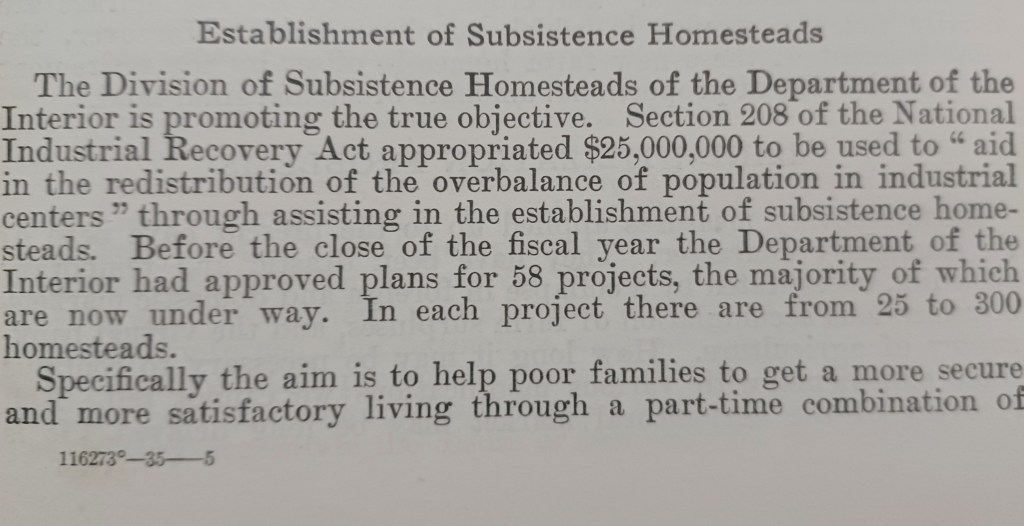
1935 USDA Yearbook of Agriculture; A different time with different solutions

I find it necessary to address the sustainability of each of the methods of growing that I will be comparing in my Mulching Comparison Experiment, Part 1. Sustainability is very important to consider when undertaking any agricultural venture. When I say sustainability I mean it very literally, not just speaking from an environmental standpoint. Can this method be sustained indefinitely under the current or foreseeable future conditions?

Continue reading

Leave a comment

Filed under agrarianism, homesteading, soil, Uncategorized

Progress or …?

One of my best sources of information in the agronomic field has been the USDA Yearbooks of Agriculture. Having access to studies from 130 years ago up until the end of publishing in 1992 has been a boon for my education. It is hard not to notice, however, the stark changes in the writing styles over those years, and the perceived shift in the target audience based on the tone of the writing. Here I will present a contrast of two randomly selected excerpts to illustrate my point.

Continue reading

Leave a comment

Filed under agrarianism, books, Uncategorized, USDA Yearbooks of Agriculture

Subsoiler aka Chisel Plow (not a hand tool)

In my last post (Battle Royale (Agrarian Style)) I revealed that I have indeed used a tool on a tractor to accomplish an agrarian goal. I used a single shank subsoiler, aka chisel plow or ripper, to help prepare a hillside to become a productive orchard. There were definitely ways that I could have used hand tools only to suit this purpose, but it would have taken years worth of work and crop rotations. This solution allowed me to jump ahead with minimal investment of time and money, and with minimal negative consequences. Read on if you are interested in the reasons behind this exception to my rule (Hand Tools: The Simple Choice).

Continue reading

1 Comment

Filed under agrarianism, hand tools, homesteading, pond, soil, trees, Uncategorized, water

Mulching Comparison Experiment, Part 1

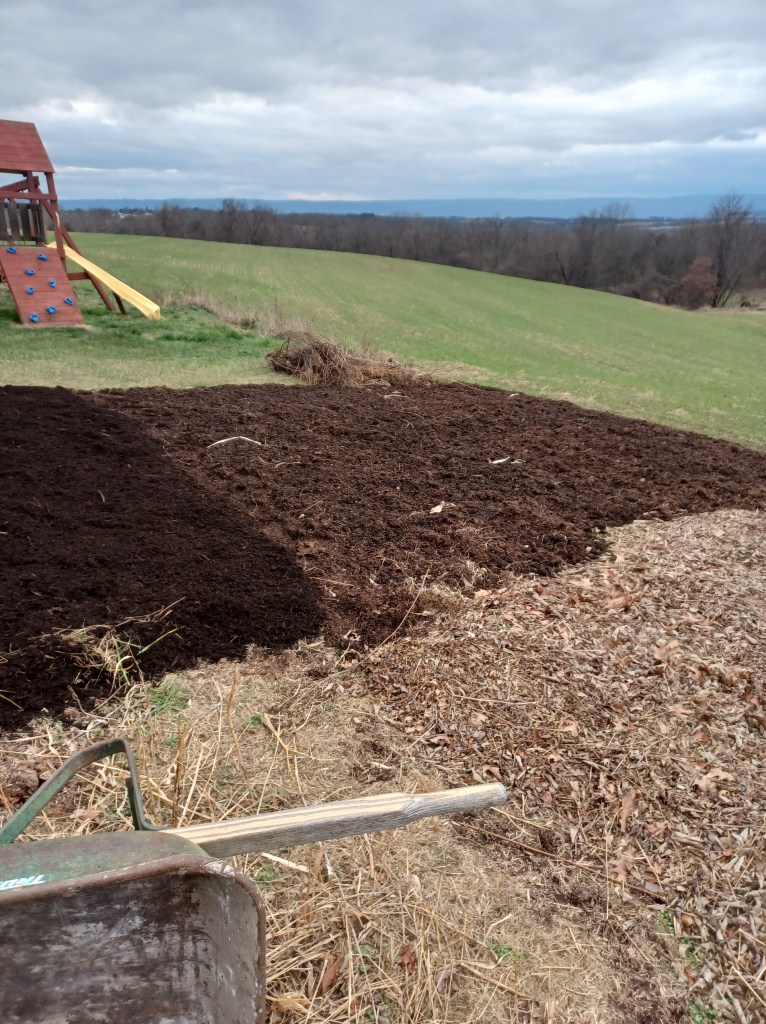
Garden with a view

I am starting new gardens from scratch this year, and in the interest of learning new things in new places (Thinking in Long Terms), I have set up an experiment to compare a few different methods of gardening. I will keep this as brief as possible, and expound upon each of these methods as I update you with progress reports over the following years. Each bed will be planted in the spring with potatoes, sweet potatoes, squash, and an assortment of vegetables, along with a row of sunflowers and buckwheat. I have no expectations or knowledge of how the results will look, this experiment is purely out of curiosity and I am excited to see how the different methods turn out. How will they yield, handle drought, soaking rains, etc?

Continue reading

2 Comments

Filed under agrarianism, food, hand tools, homesteading, soil, Uncategorized

Thinking In Long Terms

Times they are a changing. Time marches on. Time waits for no man. Time flies. There are many sayings about time and our interactions with it. Theorists would have you acknowledge that whether or not time is linear is still not a settled issue, but from a human perspective we see time pass from past to present to future at a constant rate. It may seem to speed up and slow down depending on our circumstances, but we know that each day is equal to the last, and we can’t go back and change anything after the fact. We can however affect the future with our actions in the present.

Continue reading

1 Comment

Filed under Uncategorized

Children in the Woods

childrenwoods

We often take walks in the woods.  All of us appreciate the wilderness, discovering new things on every foray.  Yesterday I got a chance to focus on a few subjects more relevant to hunting (both wild foraging and deer hunting) by leaving the path.  Leaving the path is something you only want to do if you are confident in your knowledge of the terrain, but even so it still requires some faith in yourself and random circumstance.  I of course stressed the dangers of leaving the path, and we discussed the other options available to us before putting it to a vote which was almost unanimous. Continue reading

Leave a comment

Filed under children, homeschooling, Uncategorized, wildlife, woods