Category Archives: hand tools

Black Locust Coppicing, Part 7

Edible Wood Ear fungus (the name is fitting) growing on the bark of Black Locust which had been cut last year and left to lay on the ground

Disclaimer: Outside of its native range (in and around the Appalachian Mountain range in Eastern North America) Black Locust – Robinia Pseudoacacia – can become invasive. It is a pioneer species meant to recolonize disturbed ground and compete with grass. If you are outside of its native range please proceed with caution with this species, or consider using a species native to your area that fills the same niche.

Black Locust Coppicing – Part 1, Part 2, Part 3, Part 4, Part 5, Part 6

It is now late winter – February of 2025 – and I have just bucked up the stems from last year which I had felled and left to lay on the ground. Leaving them down produced an interesting result – fungus. The sapwood and heartwood of the main stems didn’t become colonized with mycelium, but the twigs, small branches, and bark (headline picture) were in many cases well on their way into decay. This was interesting and mildly surprising given the Black Locust’s storied rot resistance, but I don’t think it was anything that would challenge its reputation as it did not affect the ‘lumber’ parts. It does answer a question I have seen – the small brush piles could be used to good effect as a hugel bed filler (a project for another day, possibly another year).

Continue reading

7 Comments

Filed under agrarianism, black locusts, coppicing, hand tools, homesteading, trees, woods

Black Locust Coppicing, Part 6

The largest stem currently is approximately 3″ diameter and 16′ tall, and was the only sprout on a 4″ diameter stool

Disclaimer: Outside of its native range (in and around the Appalachian Mountain range in Eastern North America) Black Locust – Robinia Pseudoacacia – can become invasive. It is a pioneer species meant to recolonize disturbed ground and compete with grass. If you are outside of its native range please proceed with caution with this species, or consider using a species native to your area that fills the same niche.

Black Locust Coppicing – Part 1, Part 2, Part 3, Part 4, Part 5, …, Part 7

It is now late summer of 2024, the coppicing project has yet to complete two years of growth, and I already have 1 stem (headline picture) which I am very seriously considering taking this winter. My goal with this project is to maintain a strict hand-tools only harvesting method, and anything much beyond 3″ diameter starts to become burdensome to that goal. This thickness of the base allows for a few decent split-log sized pieces as well as a gradient of sizes down to kindling twigs, without ever having to buck large rounds or split anything. Most of the stems are not close to this and will take at least another year or two to be of useful size, but they are progressing at a pace that would seem to put the average stem harvest at 4 years from coppicing. My initial thought had been that I would be harvesting on a 5-8 year rotation, and as of now it seems it may be closer to 3-5 years.

Continue reading

10 Comments

Filed under agrarianism, black locusts, hand tools, homesteading, pond, trees, woods

Black Locust Coppicing, Part 4

Disclaimer: Outside of its native range (in and around the Appalachian Mountain range in Eastern North America) Black Locust – Robinia Pseudoacacia – can become invasive. It is a pioneer species meant to recolonize disturbed ground and compete with grass. If you are outside of its native range please proceed with caution with this species, or consider using a species native to your area that fills the same niche.

Black Locust Coppicing – Part 1, Part 2, Part 3, …, Part 5, Part 6, Part 7

It is now mid-July and the stumps have mostly become unintelligible thickets surrounded with poison ivy. The largest of the sprouts are fully 1 inch in diameter and 8 feet tall. The average sprout is around 0.5 inches in diameter and 5 to 6 feet tall. Most stumps have at least 4 sprouts, but because of the poison ivy I cannot get a detailed count on each individual stump, that count will come during the winter update. We had a historically dry spring in this area, but have gotten lucky recently with intermittent storms during the hottest days bringing us to about an average weekly rainfall for summer. This has not made up for the lack of rain in the spring, but at least is maintaining things on par with a normal hot summer.

Continue reading

8 Comments

Filed under agrarianism, hand tools, homesteading, trees, Uncategorized, woods

Black Locust Coppicing, Part 3

Disclaimer: Outside of its native range (in and around the Appalachian Mountain range in Eastern North America) Black Locust – Robinia Pseudoacacia – can become invasive. It is a pioneer species meant to recolonize disturbed ground and compete with grass. If you are outside of its native range please proceed with caution with this species, or consider using a species native to your area that fills the same niche.

Black Locust Coppicing – Part 1, Part 2, … Part 4, Part 5, Part 6, Part 7

It is now mid-May and the sprouts on the stumps are clearly visible, some of them are even a couple feet tall already. Unfortunately, I failed to find a few stumps as they are currently lost in a poison ivy tangle that I am not going to wade into. Photos cannot really show all the sprouts on each stump very well, so I have taken a few representative snaps and the data will be solely numbers.

Continue reading

6 Comments

Filed under agrarianism, hand tools, homesteading, trees, woods

Black Locust Coppicing, Part 2

Disclaimer: Outside of its native range (in and around the Appalachian Mountain range in Eastern North America) Black Locust – Robinia Pseudoacacia – can become invasive. It is a pioneer species meant to recolonize disturbed ground and compete with grass. If you are outside of its native range please proceed with caution with this species, or consider using a species native to your area that fills the same niche.

Black Locust Coppicing – Part 1, … , Part 3, Part 4, Part 5, Part 6, Part 7

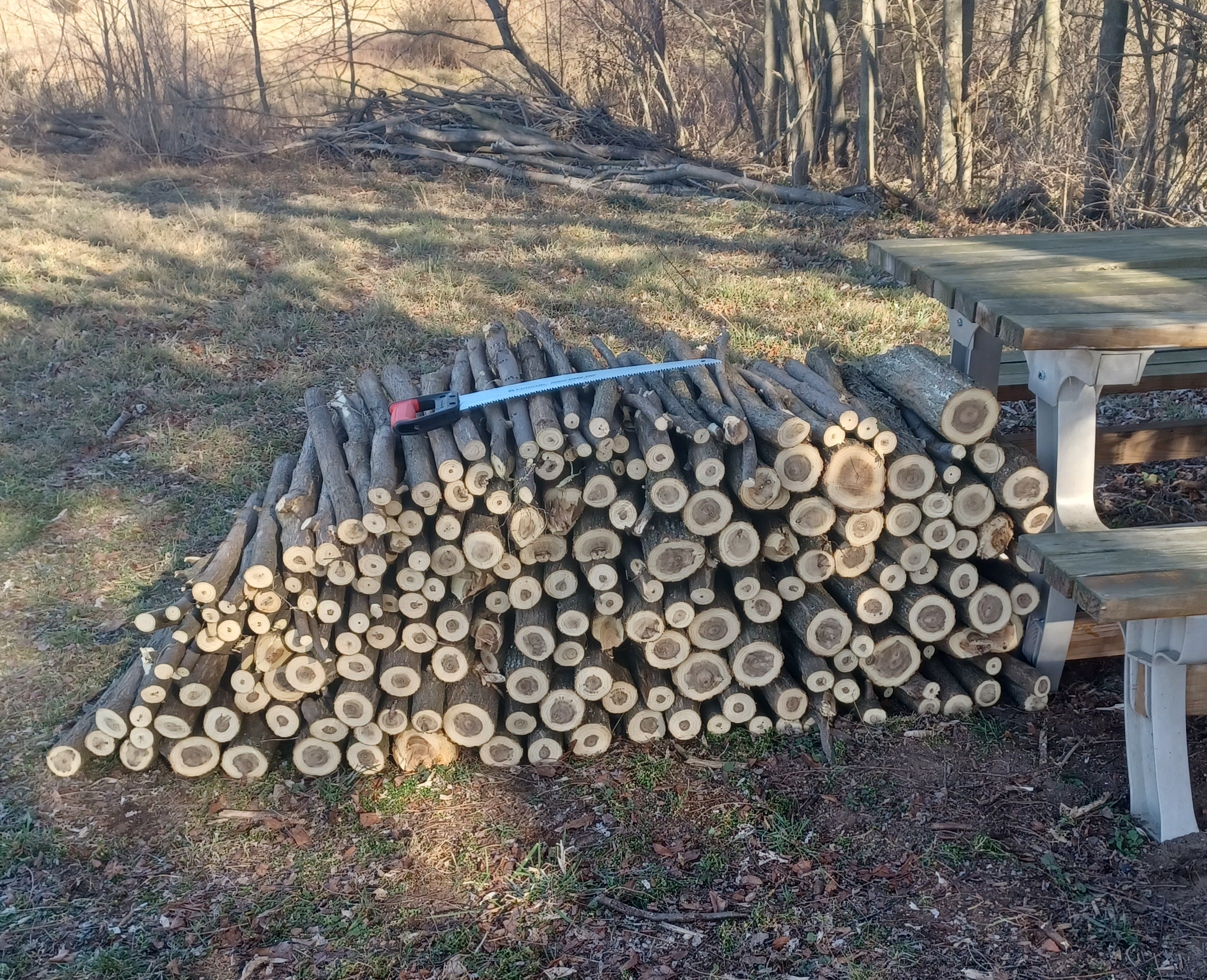
In continuing to document the coppicing project, I have above a photo of the stack of firewood from Plot A. It was cut using the saw in the picture – an 18″ Corona Razortooth pruning saw (Hand Tools: The Simple Choice), which I cannot recommend for out-of-the-box usage of this magnitude. The saw blade itself is fantastically sharp and an efficient cross-cutting tool, but the handle is less than ergonomic and quickly reveals hot-spots and pressure points. Thankfully they have the handle attached to the blade with removable screws and I intend to replace it at some point with a custom wooden handle of the proper shape. Uncomfortable handle notwithstanding, with the help of family (Helpful Children) the wood was cut in less than 3 hours.

Continue reading

9 Comments

Filed under agrarianism, hand tools, homesteading, trees, Uncategorized, woods

Black Locust Coppicing, Part 1

Pile of harvested black locust poles

Disclaimer: Outside of its native range (in and around the Appalachian Mountain range in Eastern North America) Black Locust – Robinia Pseudoacacia – can become invasive. It is a pioneer species meant to recolonize disturbed ground and compete with grass. If you are outside of its native range please proceed with caution with this species, or consider using a species native to your area that fills the same niche.

Black Locust Coppicing – …, Part 2, Part 3, Part 4, Part 5, Part 6, Part 7

In an attempt to move closer to sustainability (Thinking in Long Terms), I have begun the process of coppicing black locusts for many uses, primarily firewood for heating purposes. Black locusts have among the highest BTU’s per cord of North American trees, and have a few properties which make them endearing to me personally and to many of the homesteading persuasion. They are a pioneer species which can compete with grass species favorably if not mowed, are among the fastest growing hardwoods, are leguminous nitrogen fixers, are slightly more deer resistant than other trees due to their sharp thorns, and the wood has been known to last decades as fence posts. Their thorns do make a nuisance for the grower as well as the deer, but a good pair of leather gloves mostly makes it a non-issue. I will try to provide a detailed data-set as this project goes on so that we can all benefit from more than just anecdotes, and over time I think it will if nothing else allow me to better plan my own projects and heating needs.

Continue reading

6 Comments

Filed under agrarianism, hand tools, homesteading, trees, Uncategorized, woods

Subsoiler aka Chisel Plow (not a hand tool)

In my last post (Battle Royale (Agrarian Style)) I revealed that I have indeed used a tool on a tractor to accomplish an agrarian goal. I used a single shank subsoiler, aka chisel plow or ripper, to help prepare a hillside to become a productive orchard. There were definitely ways that I could have used hand tools only to suit this purpose, but it would have taken years worth of work and crop rotations. This solution allowed me to jump ahead with minimal investment of time and money, and with minimal negative consequences. Read on if you are interested in the reasons behind this exception to my rule (Hand Tools: The Simple Choice).

Continue reading

1 Comment

Filed under agrarianism, hand tools, homesteading, pond, soil, trees, Uncategorized, water

Mulching Comparison Experiment, Part 1

Garden with a view

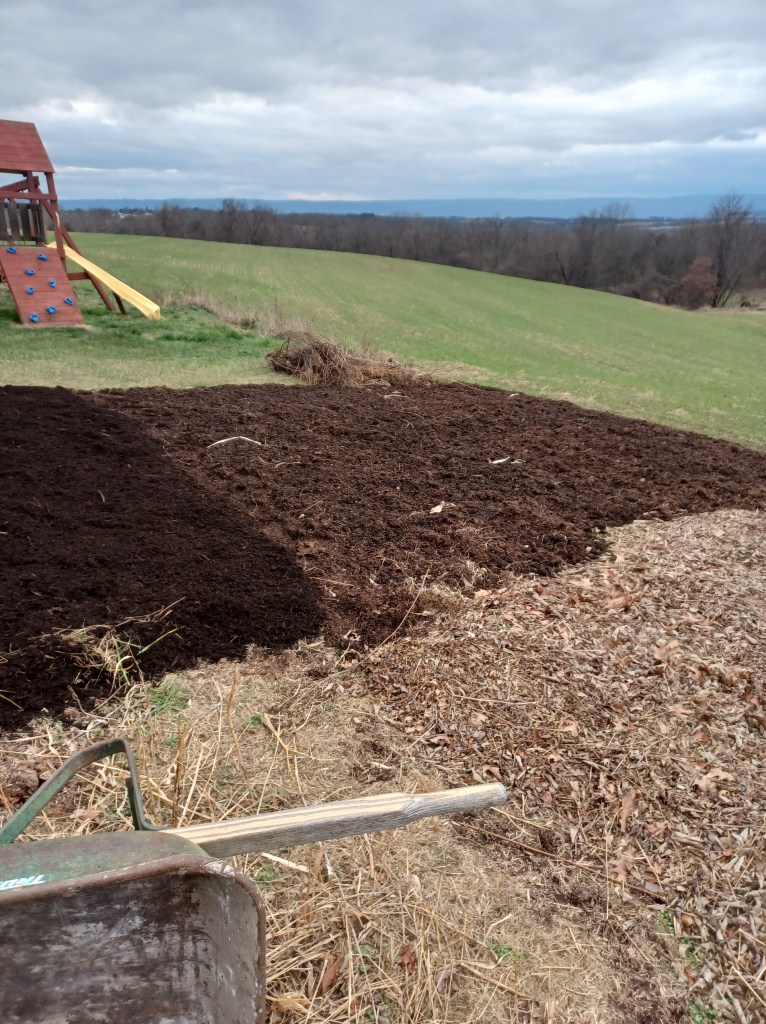
I am starting new gardens from scratch this year, and in the interest of learning new things in new places (Thinking in Long Terms), I have set up an experiment to compare a few different methods of gardening. I will keep this as brief as possible, and expound upon each of these methods as I update you with progress reports over the following years. Each bed will be planted in the spring with potatoes, sweet potatoes, squash, and an assortment of vegetables, along with a row of sunflowers and buckwheat. I have no expectations or knowledge of how the results will look, this experiment is purely out of curiosity and I am excited to see how the different methods turn out. How will they yield, handle drought, soaking rains, etc?

Continue reading

2 Comments

Filed under agrarianism, food, hand tools, homesteading, soil, Uncategorized

Hand Tools: The Simple Choice

Sickle_and_scythe_labels

When explaining my decision to use only hand tools to accomplish all of my tasks, as an agrarian I could give the simple answer: they guarantee my commitment to hard work. Often times, I stop the explanation there. When approaching a project, I would rather choose the path that puts my body to work, giving my mind time to think while my body completes the task at hand, rather than only using my mind while letting my body languish. It is more satisfying and more healthful this way. I don’t use hand tools just because I enjoy it more, though. It is logic on many levels which led me to this decision. Continue reading

3 Comments

Filed under agrarianism, hand tools