
Disclaimer: Outside of its native range (in and around the Appalachian Mountain range in Eastern North America) Black Locust – Robinia Pseudoacacia – can become invasive. It is a pioneer species meant to recolonize disturbed ground and compete with grass. If you are outside of its native range please proceed with caution with this species, or consider using a species native to your area that fills the same niche.
Black Locust Coppicing – Part 1, … , Part 3, Part 4, Part 5, Part 6, Part 7
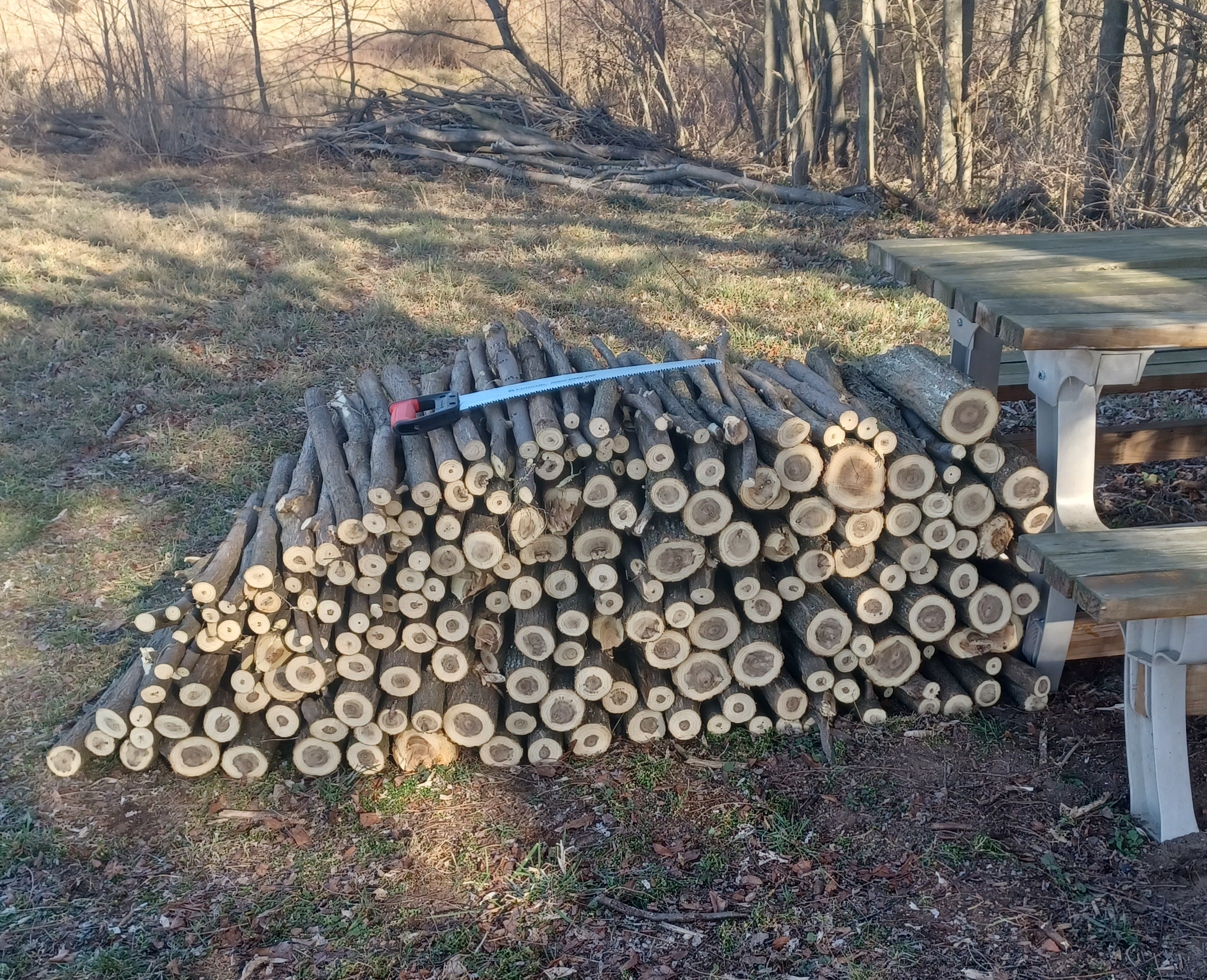
In continuing to document the coppicing project, I have above a photo of the stack of firewood from Plot A. It was cut using the saw in the picture – an 18″ Corona Razortooth pruning saw (Hand Tools: The Simple Choice), which I cannot recommend for out-of-the-box usage of this magnitude. The saw blade itself is fantastically sharp and an efficient cross-cutting tool, but the handle is less than ergonomic and quickly reveals hot-spots and pressure points. Thankfully they have the handle attached to the blade with removable screws and I intend to replace it at some point with a custom wooden handle of the proper shape. Uncomfortable handle notwithstanding, with the help of family (Helpful Children) the wood was cut in less than 3 hours.
The stack measured approximately 2’x2’x5′ = 20 cu. ft. A cord of firewood is 128 cu. ft. 20/128 = 5/32 or 0.15625 cords from Plot A. To extrapolate into a nice neat measurement – Plot A was 1/19th of an acre and grew for 10 undisturbed years, so 0.15625 * 19 = 2.96875 then /10 = 0.296876 cords/acre/year. Although this may seem quite underwhelming, I am indeed ecstatic about this result.
I hypothesize that this result represents the lower boundary of possible outcomes, as the seedlings first years are the hardest and slowest growth that the tree will experience until senescence, with the smallest of root systems under it. As the sprouts come up after this cutting, they will grow very quickly to a height that will already be above the neighboring competition, rather than fighting against grass to get started. The root systems are already established and contain quite a bit of energy waiting to accelerate the first year of growth for more than just one stem. This is a key point to keep in mind – the regrowth will be many stems, and with my past experience as a guide may in fact be so many stems that I will be thinning them out this first year just to be able to walk through safely. These multiple stems will each be growing much faster than the seedling did for the first 2-3 years of its life, and I fully expect to be harvesting the same size stems from the regrowth in anywhere from 5-8 years instead of 10 years.
A realistic hypothetical in my mind would be twice this volume harvested 8 years from now. I believe the true result will be much more impressive than this but this I think is a very realistic hypothetical. 40 cu. ft. / 128 cu. ft. = 0.3125 cords * 19 = 5.9375 cords/acre then /8 = 0.7421875 cords/acre/year. Almost 3/4 cord per acre per year could be the very next harvest, and I would also hypothesize that each successive harvest would grow until reaching a sort of equilibrium, the level of which I can’t even attempt to predict. The generally accepted number for sustainable forestry is that you can sustainably harvest 1 cord per acre per year from an established and well managed woodland. I believe coppicing has the capacity to outshine this number, while making a harvest that doesn’t require large machinery or high levels of danger in felling. Only time will tell.
I am excited to document the sprouting in the months to come!

 Anonymous Appalachian Agrarian
I have a thicket if black locust on my property and will be expanding it for firewood, tool crafting and building materials. I’ve been binging everything I can find to learn more and am excited for your progress reports. Thanks for documenting!
LikeLike
Sprouts update will be within the next week or so. Great to hear you are working on a coppice for yourself! So many other species are also useful in this regard, Honey Locust being one (surprisingly no relation to Black Locust even).
LikeLike
I walked along my mixed woodline yesterday with a few black locust mothers, none of which have been cut or prompted to spread more than usual. In the span of about 50 yards I counted 77 sprouts!
I plan to make a hedgerow around the property and undecided as to whether I should let these sprouts grow and transplant over winter, or harvest a ton of seeds (scarify & boil to germinate) and plant en mass come next spring. Probably both.
With a rate of spread that aggressive under perfectly normal conditions, I can’t imagine how aggressive these beasts must get once coppiced.
LikeLike
Pingback: Black Locust Coppicing, Part 1 | Anonymous Appalachian Agrarian
Pingback: Black Locust Coppicing, Part 3 | Anonymous Appalachian Agrarian
Pingback: Black Locust Coppicing, Part 4 | Anonymous Appalachian Agrarian
Pingback: Black Locust Coppicing, Part 5 | Anonymous Appalachian Agrarian
Pingback: Black Locust Coppicing, Part 6 | Anonymous Appalachian Agrarian
Pingback: Black Locust Coppicing, Part 7 | Anonymous Appalachian Agrarian